[2003] Dew poisoning on Isis’ legs
Just before I started this blog in 2004, Isis had a record year for Bad Things. Okay, not as bad as later years, but up until that time it was Bad. Laminitis, rain rot, sprained tendon, and dew poisoning.
A reader asked a question about Isis’ February 2006 case of belly gunk. In addition to her gelding having the same belly gunk that Isis had, he also has a bad case of scratches or dew poisoning.
Back in the winter of 2002/2003, Isis had a horrible case of dew poisoning. I had not documented what happened with her case on the blog so I am writing about it now. Just in case what I learned can help someone else (like 3horsemom who commented on the Belly Gunk post).
Bad scratches, no donut
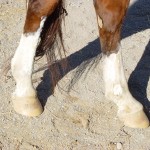
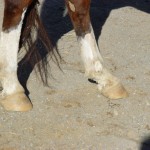
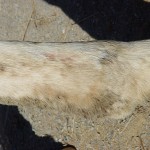
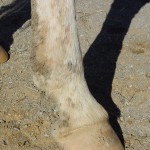
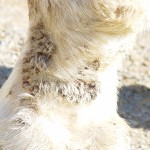
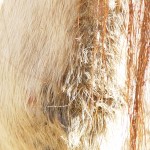
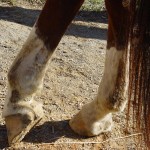
Isis’s 2002/2003 case of dew poisoning (a.k.a., scratches), a skin condition that causes crusty scabs, inflammation, and irritation to the horse, was bad enough that she was lame. Dew poisoning most often appears on the horse’s heels or around the pasterns on legs with white socks. In mild cases, the horse has some bumps that are easily treated. In bad cases, the horse may be lame from the painful scabs and have swelling.
Her worst case of dew poisoning started around Thanksgiving of 2002 as a few small bumps behind her fetlocks on her back feet. I treated them by washing her legs with antibacterial soap (so much fun in cold weather), clipping long hair from around the scabs, and picking off the scabs before applying zinc oxide ointment. Over the course of the winter, the dew poisoning got better.
By mid January, the scabs had exploded all over her legs. The scabs went from her hocks to her coronary band on her back white stockings, her front white sock had scabs, and so did her front black. Her back legs were the worse. The scabs were as thick as my thumb in some places. (Other cases of dew poisoning I’ve treated on my mares, the scabs are the size of small beads clumped together.) When the scabs were pulled off, she bled.
Treatment
I finally had the vet out. The treatment she gave me worked for Isis, so I’ll repeat it here:
- If the horse is in a wet or unsanitary pasture, change the environment if possible. (The quality of the care wasn’t an issue in Isis’ case. We were able to turn her out later so she avoided the dew on the grass.)
- Do not pull the scabs off. They will fall off as they heal. Pulling scabs off irritates the skin underneath and can actually cause the stuff to spread.
- Gently wash the area periodically with an antifungal/antibacterial shampoo. You don’t have to wash every day.
- Use an ointment on the scabs to kill the gunk causing the scabs. Some people use zinc oxide, Monostat (yeast infection treatment for people), or other concoctions (see recipe below).
It took several weeks for the scabs to disappear and for Isis’ legs to heal properly.

Recipe
The goop I used on Isis was made up of:
- 1 ounce of .5% hydrocortisone cream
- 1 ounce of Desitine (the kind in the jar, not the tube)
- .5 ounce of Desinex (athlete’s foot powder)
- 1 ounce Nitrofuracin ointment
I mixed the ingredients in an old Cool Whip container using a plastic spoon.
One Comment